
Corresponsables has published an in-depth interview with Miguel Ángel García Tamargo, Founder and CEO of NatureBrain.
The conversation explores how artificial intelligence can change the way companies measure, value and manage natural capital.
It also looks at the growing connection between nature, technology and finance. In particular, the interview explains how Helena AI transforms complex environmental data into measurable and actionable intelligence.
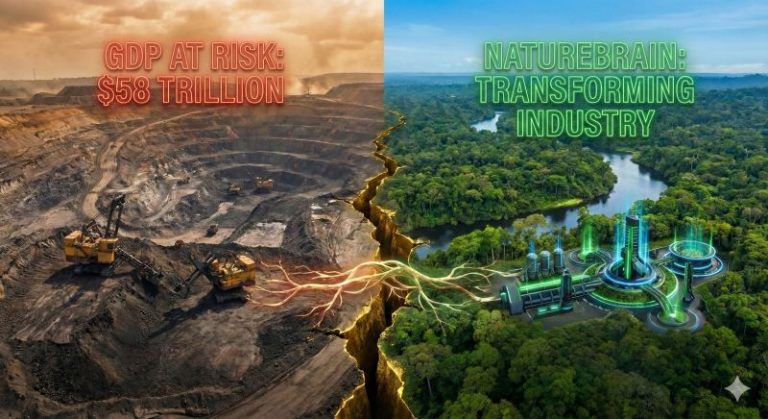
At the centre of the conversation is a simple idea: nature is not only an environmental issue. It is also an economic asset that creates value and requires investment.
Turning natural capital into measurable intelligence
Natural capital involves many different variables. These include climate, soil quality, biomass, biodiversity, temperature and forest inventories.
Future climate scenarios also play an important role.
NatureBrain brings this information together through Helena AI.
The platform combines environmental data with artificial intelligence, mathematical models and predictive analytics. This helps organisations understand how natural assets may change over time.
NatureBrain currently integrates more than 67 data layers through Google Earth Engine. It also uses scientific research, environmental regulation and climate models.
Together, these sources help NatureBrain analyse natural assets and support better environmental and financial decisions.
Artificial intelligence supported by human expertise
Artificial intelligence plays a central role in analysing large volumes of environmental information.
However, NatureBrain does not use AI to replace human expertise.
Helena AI uses different Gemini models depending on the type of analysis. NatureBrain then combines them with its own algorithms, data architecture and analytical processes.
Specialists also review the results.
The team includes forestry engineers, environmental engineers and experts in wetlands and oceans.
This approach allows technology to speed up complex analysis while experts maintain oversight.
Clients therefore receive more than an AI-generated result. They receive expert analysis supported by AI, environmental data and predictive modelling.
Why natural capital needs economic value
The Corresponsables interview also explores one of NatureBrain’s core ideas: companies should recognise and manage natural capital as an economic asset.
Many businesses depend directly or indirectly on ecosystem services.
Water, forests, soil and biodiversity can affect production, operating costs, risk and long-term profitability.
Traditional financial analysis often fails to reflect these dependencies.
Natural capital valuation helps companies understand what they depend on. It also helps them identify risks and decide where investment may be necessary.
The goal is not simply to put a price on nature.
Instead, the goal is to give decision-makers better information about the economic importance of natural systems.
Three approaches to valuing nature
During the interview, Miguel Ángel García Tamargo explains three main approaches to estimating the economic value of natural assets.
The first is replacement cost. This approach calculates how much it would cost to restore an asset after damage or degradation.
The second is comparison. It uses similar assets or situations as a reference when reliable comparisons exist.
The third focuses on utility. It analyses the economic benefits that a natural asset can generate over time.
This approach often requires more complex modelling.
Artificial intelligence can help analyse different variables and build future scenarios. It can also estimate how ecosystem services may create economic value.
As a result, companies can use environmental information in financial planning, investment decisions and risk management.
From sustainability commitments to verifiable evidence
The interview also highlights the growing demand for transparency around sustainability claims.
Companies, investors, banks and public organisations increasingly need measurable evidence of environmental results.
NatureBrain supports this process through monitoring and verifiable KPIs.
Satellite imagery and environmental data can track changes across ecosystems. They can also cover large geographical areas and provide regular updates.
This makes it easier to assess whether a restoration or conservation project is delivering the expected results.
It also reduces the need to rely only on repeated on-site measurements.
Investors, banks, insurers, companies and public administrations can therefore evaluate environmental performance with stronger evidence.
They can also assess whether their investment is creating measurable impact.
Natural capital could become part of mainstream financial management
The interview also looks at the future of natural capital in corporate and financial reporting.
Miguel Ángel highlights 2030 as a possible turning point.
By then, regulation, investors, banks and insurers may place much greater importance on companies’ impacts and dependencies on nature.
The direction is already becoming clear.
Organisations will need better tools to analyse both natural assets and natural liabilities.
Artificial intelligence will play a key role because environmental information is complex and vast.
NatureBrain is developing Helena AI around this challenge.
The platform helps organisations turn complex environmental data into useful intelligence. Companies can then evaluate risk, compare scenarios and make better decisions.
Sustainability as a source of long-term value
The interview closes with a message that reflects NatureBrain’s wider vision:
“Ser sostenible no debe ser una obligación, debe ser un acto de rentabilidad.”
Sustainability should not sit apart from economic performance.
For companies that depend on natural resources, protecting those assets also protects their long-term ability to create value.
Technology now gives organisations better tools to understand this relationship.
With better measurement, companies can move beyond assumptions and commitments.
They can make decisions based on data, evidence and predictive intelligence.
We thank Corresponsables for the opportunity to share NatureBrain’s vision on artificial intelligence, natural capital and sustainable investment.
Read the full interview on Corresponsables
Discover the complete conversation with Miguel Ángel García Tamargo.
Learn more about how NatureBrain and Helena AI are helping turn natural capital into measurable and actionable intelligence.